---
title: Introducing the new PakScan
description: Discover the new PakScan model, designed for flexible seal integrity testing. Experience faster, reliable results across various packaging formats.
---
[SEPHA](https://sepha.com/)
[Contact](https://sepha.com/contact/)
- Our Solutions
- [Products](https://sepha.com/products)
- [Leak Testing Solutions](https://sepha.com/products/leak-testing/)
- [Packaging Solutions](https://sepha.com/products/packaging-solutions/)
- [Deblistering Solutions](https://sepha.com/products/deblistering/)
- [Container Types](https://sepha.com/container-types)
- [Blister Packs](https://sepha.com/container-type/blister-packs/)
- [Bottles](https://sepha.com/container-type/bottles/)
- [IV Bags](https://sepha.com/container-type/iv-bags/)
- [Vials](https://sepha.com/container-type/vials/)
- [Ampoules](https://sepha.com/container-type/ampoules/)
- [Pre-filled Syringes](https://sepha.com/container-type/pre-filled-syringes/)
- [Flexible Packaging](https://sepha.com/container-type/flexible-packaging/)
- [Medical Device Packaging](https://sepha.com/container-type/medical-device-packaging/)
- [Test Methods](https://sepha.com/test-methods)
- [Vacuum Decay](https://sepha.com/test-methods/vacuum-decay/)
- [Pressure Decay](https://sepha.com/test-methods/pressure-decay/)
- [Force Decay](https://sepha.com/test-methods/force-decay/)
- [Vacuum Deflection](https://sepha.com/test-methods/vacuum-deflection/)
- [3D Volumetric Measurement](https://sepha.com/test-methods/vacuum-deflection/#volumetric-measurement)
- Standards & Regulations
- [ASTM F2338-09](https://sepha.com/standards/astm-f2338-09/)
- [ASTM F3169-16](https://sepha.com/standards/astm-f3169-16/)
- [USP 1207](https://sepha.com/regulations/usp1207/)
- [21 CFR Part 11](https://sepha.com/regulations/21-cfr-part-11/)
- [Services](https://sepha.com/services/)
- [Contract Packaging](https://sepha.com/services/contract-packaging/)
- [Insights & Resources](https://sepha.com/insights-and-resources/)
- [Resources](https://sepha.com/resources)
- [Blog & News](https://sepha.com/blog-news/)
- [Events](https://sepha.com/events)
- [FAQs](https://sepha.com/faq/)
- [Contact](https://sepha.com/contact/)
- [Support](https://sepha.com/support/)
- [info@sepha.com](mailto:info@sepha.com)
- [+44 (0)28 9048 4848](tel:+44(0)2890484848)
- [Our Organisation](https://sepha.com/our-organisation/)
# Introducing the latest PakScan model
# Introducing the latest PakScan model
## A more flexible approach to seal integrity testing for flexible packaging
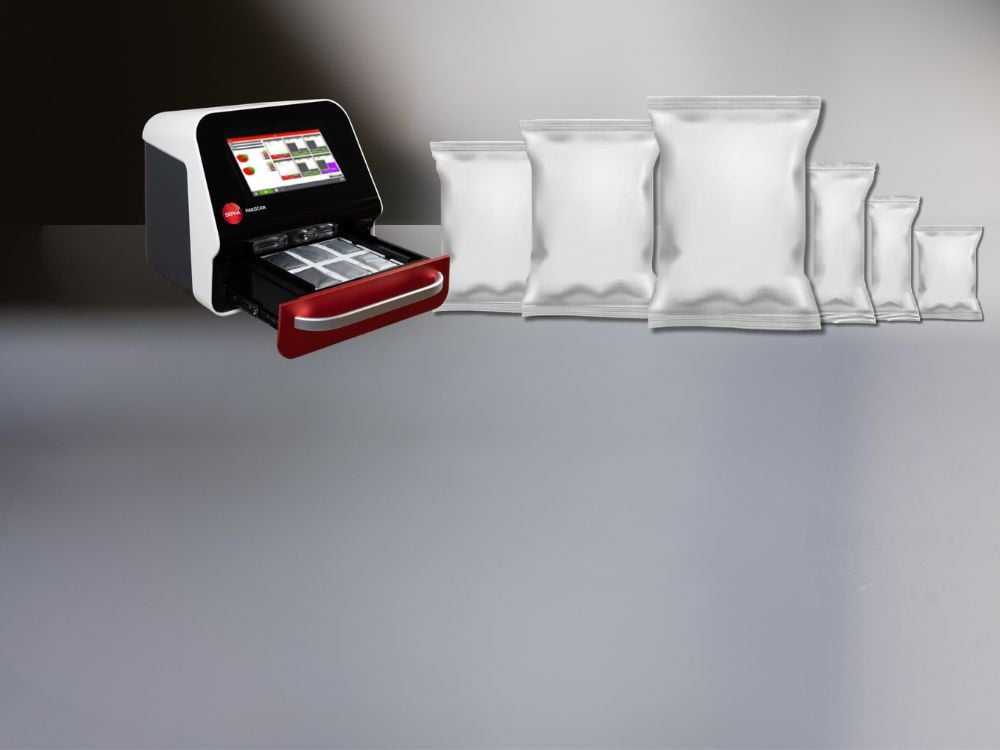
The redesigned PakScan introduces a more flexible system for seal integrity testing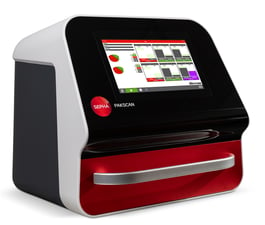 of non-porous flexible packaging and semi-rigid trays with non-porous lidding.
Designed to test multiple pack sizes on a single machine through configurable layouts, the PakScan provides greater flexibility across your product range.
Using force decay technology combined with vacuum decay, the instrument can detect seal defects, pinholes, gross holes and other package integrity failures as low as 10µm.
## What Makes the New PakScan Different
- Flexible test layouts for multi-pack testing
The PakScan introduces a unique load-cell design, supporting 1-up, 2-up, 3-up and 6-up test layouts with defined pack sizes. This allows different pouch and sachet formats to be tested on a single machine, enabling manufacturers to use one system across multiple packaging formats.

- **Selectable load-cell activation**
Individual load cells can be switched on or off to allow partial use of a layout (e.g. 5 packs in a 6-up layout), ensuring accurate results by preventing false failures from unused load cells .
- **Improved test time**
Test time can be as little as 10 seconds (pack and material dependent)
- **Improved ergonomics & compact design**
A front-loading drawer provides easy access for loading and unloading packs, improving usability and operator ergonomics. The compact footprint allows the PakScan to be positioned closer to the production line, reducing the need to move products to separate testing areas and improving efficiency and workflow.
- **Handles packs with low-headspace**
Pouches and sachets can be difficult to test, as limited internal air reduces expansion under vacuum. By reaching higher vacuum levels, the new PakScan creates a greater pressure differential, enabling reliable detection of micron defects even in low-headspace packs.
## Non-destructive testing and sustainability
Deterministic, non-destructive testing ensures objective pass/fail results for every pack, while preserving product after testing.
By keeping packs intact during testing, the PakScan also helps reduce product waste, supporting sustainability and carbon reduction initiatives.
## Pack Dimensions
| **Equipment** | **Description** |
| --- | --- |
| Measurement System (load cell) | 1, 2, 3 or 6-up layout |
| Pack Size | 1-up -> 275mm x 304mm x 55mm 2-up -> 137mm x 304mm x 55mm 3-up -> 275mm x 100mm x 55mm 6-up -> 137mm x 100mm x 55mm |
| Test Chamber | +0mb to -1000mb |
## Packaging Types
The PakScan is designed for seal integrity testing of packaging commonly used across pharmaceutical, medical device and diagnostic applications. This includes sealed flexible packaging made from non-porous materials, including films, laminates and foils, as well as semi-rigid trays or cups sealed with non-porous lidding.
Typical packaging formats include:

✔ Flexible formats including pouches, sachets, stick packs, doy packs and pillow packs
✔ Packs containing powder, tablets, capsules, medical devices or diagnostic kits
✔ Combination products packaging (e.g. auto-injectors, pre-filled syringes with implants)
✔ Laminate pouches containing blister packs
✔ Transdermal patch packaging
✔ Semi-rigid trays or cups with non-porous lidding
The PakScan supports a wide range of flexible packaging formats. If your packaging isn’t listed, get in touch to discuss your specific application.
Contact us on +44(0)28 9048 4848, use the enquiry form on this page or email [info@sepha.com](mailto:info@sepha.com).
### Sign up for our Sepha newsletter
Sign Up
[SEPHA](https://sepha.com/)
[Twitter](https://twitter.com/sephaltd?lang=en) [Linkedin](https://www.linkedin.com/company/sepha-ltd)
Founded in 1980
SEPHA has established a global reputation for innovation and development of specialised, high quality equipment for use in the manufacture of pharmaceutical blister packs, medical device and healthcare products. Our products enable customers to create high quality blister packs, to accurately detect leaks and weak seals in packaging, and to recover high value products from blister packs.
### Products
- [Leak Testing](https://sepha.com/products/leak-testing/)
- [Multi-Q](https://sepha.com/products/leak-testing/multi-q/)
- [PakScan](https://sepha.com/products/leak-testing/pakscan/)
- [VisionScan 3D](https://sepha.com/products/leak-testing/visionscan-3d/)
- [Deblistering](https://sepha.com/products/deblistering/)
- [PressOut Manual Wide](https://sepha.com/products/deblistering/pressout-manual-wide/)
- [PressOut Semi-Automatic](https://sepha.com/contact/pressout-semi-automatic/)
- [PressOut Universal](https://sepha.com/products/deblistering/pressout-universal/)
- [PressOut Universal Mini](https://sepha.com/products/deblistering/pressout-universal-mini/)
- [Clic-Open Ampoule Opener](https://sepha.com/products/deblistering/clic-open/)
- [Packaging](https://sepha.com/products/packaging-solutions/)
- [EZ Blister](https://sepha.com/products/packaging-solutions/ez-blister/)
- [EZ Blister+](https://sepha.com/products/packaging-solutions/ez-blister-plus/)
- [EZ Blister MAP](https://sepha.com/products/packaging-solutions/ez-blister-map/)
- [EZ MedPak](https://sepha.com/products/packaging-solutions/ez-medpak/)
### Connectivity
- [MESConnect](https://sepha.com/connectivity/mes-connect/)
### Container Types
- [Blister Packs](https://sepha.com/container-type/blister-packs/)
- [Bottles](https://sepha.com/container-type/bottles/)
- [IV Bags](https://sepha.com/container-type/iv-bags/)
- [Vials](https://sepha.com/container-type/vials/)
- [Ampoules](https://sepha.com/container-type/ampoules/)
- [Pre-filled Syringes](https://sepha.com/container-type/pre-filled-syringes/)
- [Flexible Packaging](https://sepha.com/container-type/flexible-packaging/)
- [Medical Device Packaging](https://sepha.com/container-type/medical-device-packaging/)
### Standards & Regulations
- [ASTM F2338-24](https://sepha.com/standards/astm-f2338-24/)
- [ASTM F3169-16](https://sepha.com/standards/astm-f3169-16/)
- [USP 1207](https://sepha.com/regulations/usp1207/)
- [21 CFR Part 11](https://sepha.com/regulations/21-cfr-part-11/)
### Test Methods
- [CCIT](https://sepha.com/test-methods/container-closure-integrity-testing/)
- [Vacuum Decay](https://sepha.com/test-methods/vacuum-decay/)
- [Pressure Decay](https://sepha.com/test-methods/pressure-decay/)
- [Force Decay](https://sepha.com/test-methods/force-decay/)
- [Vacuum Deflection](https://sepha.com/test-methods/vacuum-deflection/)
- [3D Volumetric Measurement](https://sepha.com/test-methods/vacuum-deflection/#volumetric-measurement)
### Services
- [Our Services](https://sepha.com/services/)
### Insights & Resources
- [Customer Stories](https://sepha.com/customer-stories/)
- [Resources](https://sepha.com/resources/)
- [Blog & News](https://sepha.com/blog-news/)
- [Events](https://sepha.com/events/)
- [FAQS](https://sepha.com/faq/)
### Links
- [Our Organisation](https://sepha.com/our-organisation/)
- [Meet our team](https://sepha.com/our-organisation/meet-our-team/)
- [Contact](https://sepha.com/contact/)
- [Privacy Policy](https://sepha.com/privacy-policy/)
- [Cookie Policy](https://sepha.com/cookie-policy/)
- [Tax Strategy](https://www.tasigroup.com/uk-tax-strategy-statement/)
Copyright © 2024 Sepha. All rights reserved.
Wurkhouse
[Site by WURKHOUSE](https://wurkhouse.com)